ED Nurses Ditching Pockets: Why Fanny Packs Win Shifts
ED nurses are ditching undersized pockets for fanny packs and waist organizers. Discover why this shift improves efficiency, organization, and comfort during demanding emergency department shifts.

The Pocket Problem: Why ED Nurses Are Making a Change
It's 11 p.m. in the emergency department, and you're three patients deep with no end in sight. Your pockets, which seemed spacious at shift start, now feel like tiny black holes. You've got trauma shears, pens that keep disappearing, tape, alcohol swabs, a phone, and the stethoscope everyone keeps "borrowing." Your scrub pants are sagging from weight, and every time you bend down to help a patient, something falls out.
This is the reality that's driving a quiet revolution in emergency departments across the country. Hospital scrubs often have just one pocket on top and one in back, with small pockets that are never enough for essential items. Instead of fighting this limitation, smart ED nurses are abandoning pockets altogether and switching to a better solution: waist-worn fanny packs or nurse tool belts.
At Bobcat Medical, built right here in Sacramento, CA, we've spent the last couple of years serving over 1,000 healthcare professionals who face this exact challenge every shift. What we see is clear: the traditional pocket system wasn't designed for modern emergency medicine, and nurses know it.
Why Pockets Fail in High-Stress Environments
Research shows the average nurse walks between 3 to 6 miles per shift , and that constant movement in the ED creates a perfect storm for pocket failures. Here's what happens in real practice:
- Weight distribution problems: Overloaded pockets pull your scrubs down, create an uneven weight load, and cause back strain during 12-hour shifts.
- Lost supplies: In high-acuity moments, items fall out during patient transfers, CPR, or when squeezing through crowded hallways.
- Hygiene concerns: Pockets absorb sweat, bodily fluids, and contaminants, making proper disinfection nearly impossible.
- Inefficient access: Reaching into multiple pockets wastes precious seconds when you need tape, shears, or your penlight during time-sensitive situations.
- Organization chaos: Without compartments, your essential tools mix with pens, personal items, and notes, slowing down your workflow.
Research on ED patient flow management reveals that access to resources is the single most important factor influencing workflow, and patient management is impeded by insufficient access to equipment and supplies. Pockets don't solve this; they actually compound the problem by keeping your most-used tools scattered and hard to reach.
The Fanny Pack Renaissance: Designed for Real ED Shifts
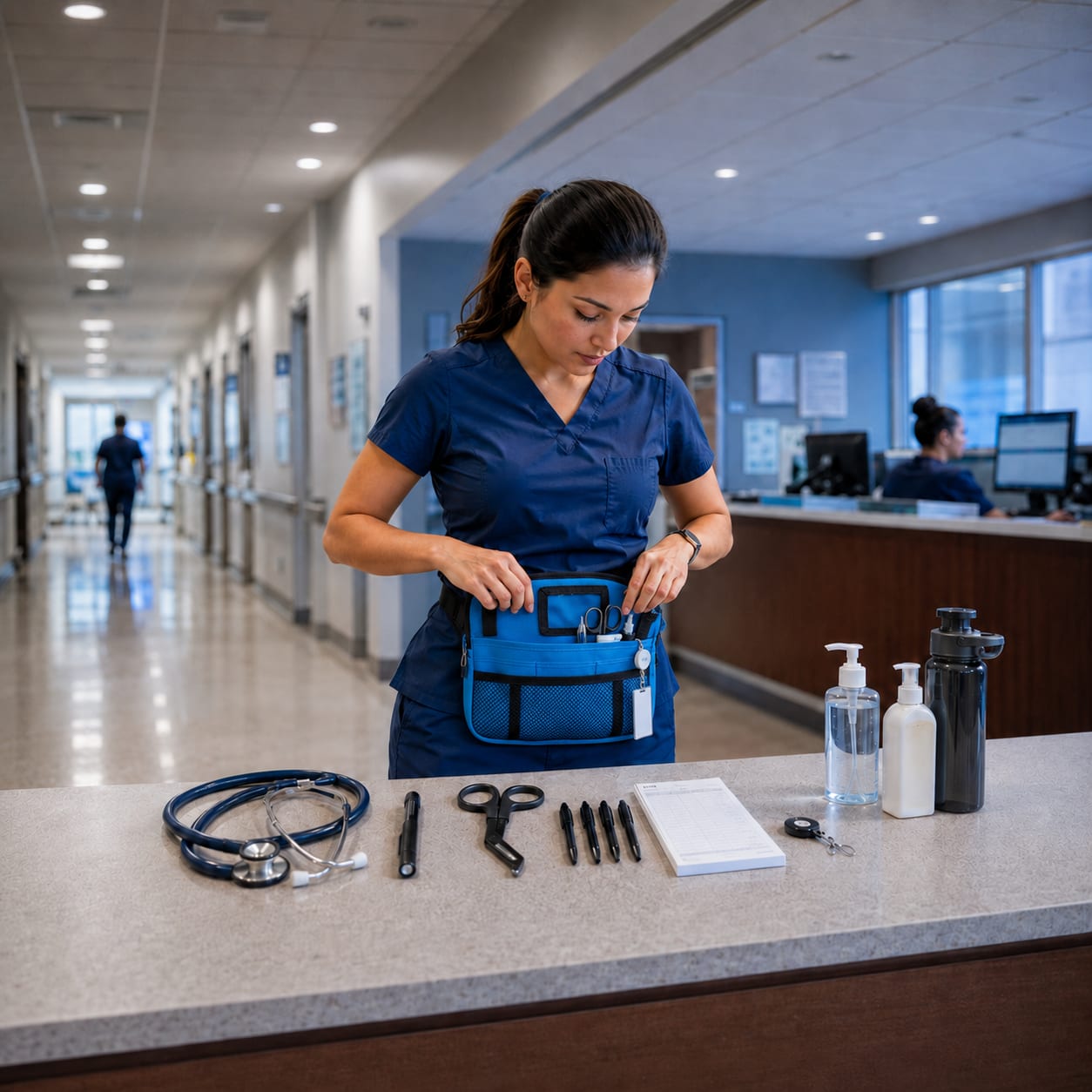
A quality nurse fanny pack or waist organizer isn't a fashion statement; it's a tactical upgrade to your clinical efficiency. Unlike pockets, these tools are built specifically for the demanding work you do.
Here's what makes them work:
- Dedicated compartments: Specific slots for your stethoscope, tape holder, scissors, pens, and supplies mean you never waste time searching for anything.
- Hands-free accessibility: Everything sits at waist level where you can reach it without digging through fabric, even while wearing gloves or caring for a patient.
- Ergonomic design: Waist bags with ergonomic designs allow nurses to carry essential tools in an orderly and secure manner, enhancing efficiency. The weight distributes evenly around your center of gravity instead of tugging your scrubs sideways.
- Easy to clean: Unlike pockets, quality fanny packs are typically made from wipeable, water-resistant materials that hold up to hospital-grade disinfectants.
- Visible, organized storage: Your tools stay visible and in one place, preventing the "where did I put that?" moments that cost you minutes across a shift.
Our experience serving ED professionals shows that once you switch to a well-designed fanny pack, you don't go back. One of our customers, a busy Sacramento emergency nurse, told us she reclaimed nearly 10 minutes per shift just from having everything organized and within arm's reach. That's over an hour a week, time that goes directly to patients instead of searching for supplies.
The Right Gear Makes the Difference
Not all fanny packs are created equal. The ones that work best for ED nursing have specific features that align with how you actually move through your shift. You need dedicated stethoscope holders (whether magnetic or hook-and-loop), secure tape compartments, and enough pockets for pens, alcohol swabs, and your essentials without turning into a bulky mess.
Our nurse fanny packs are field-tested by people who work shifts like yours, because our whole team comes from healthcare. We understand that your gear needs to move with you through code situations, trauma activations, and 16-hour days without falling apart or leaving you weighed down.
For comparison on stethoscope security, our detailed breakdown of magnetic vs. hook-and-loop stethoscope holders helps you choose what works best for your workflow. Many ED nurses prefer the quiet, reliable hold of a hook-and-loop system that keeps your scope exactly where you left it.
The best fanny pack setup for emergency medicine combines:
- Multiple compartments for organization
- Durable, water-resistant materials that survive the ED environment
- A secure stethoscope holder so your scope doesn't disappear
- An adjustable waist strap that fits securely without shifting
- Lightweight construction so you're not adding unnecessary burden to long shifts
Real Workflows, Real Solutions
If you've read anything about nursing efficiency, you've probably seen that nurses spend only 18% of their time with patients, with much of the rest spent walking and retrieving supplies. While you can't eliminate ED design constraints, you can optimize what you control: how you carry and access your tools.
Taking care of yourself during demanding shifts isn't just about mental health; it's also about how efficiently you can move through your day. When you're not fighting with overloaded pockets or hunting for supplies, you're less stressed and more present with patients.
The ED nurses ditching pockets aren't being trendy. They're being strategic. They're saying, "I'm going to solve this one problem I can control so I have more energy for the ones I can't." That's the philosophy we bring to everything we make, practical solutions built by professionals, for professionals.
Getting Started: Your Shift Upgrade
Making the switch from pockets to a fanny pack takes maybe one shift to adjust to. By shift two, you'll wonder why you didn't do it earlier. You'll spend less time searching, more time with patients, and your back will thank you.
Our fanny packs come with a 30-day money-back guarantee, so there's zero risk in trying a setup that thousands of healthcare professionals have already made work. We offer free shipping on orders over $50 across the continental US, and we're proud to operate from Sacramento, CA, serving healthcare professionals nationwide with gear that's been tested in actual clinical environments, not just designed in an office.
Browse our full collection of nurse fanny packs and medical accessories and find the right organizer for your shift. If you're unsure which option fits your workflow, our team is here to help. We're not going to upsell you on gear you don't need; we're here to help you find what actually works.
Your shift is demanding enough without fighting your own pockets. Make one small change that gives you back precious time and energy every single day. Shop our nurse fanny packs today and join thousands of ED professionals who've already ditched pockets for the better.
Frequently Asked Questions
Q: Will a fanny pack get in the way during patient care?
No. When worn correctly at your waist, a quality fanny pack sits low and tight against your body and won't interfere with patient care, CPR, or movement. Many ED nurses actually find they have more mobility than with heavy pockets pulling their scrubs down. If you need your hands completely free during a specific procedure, most packs allow you to temporarily unhook the waist belt.
Q: Can I actually fit all my essentials in a fanny pack?
Yes. A well-designed nurse fanny pack with multiple compartments can hold your stethoscope, tape, scissors, pens, alcohol swabs, phone, and personal items. The key is choosing one with dedicated pockets instead of a single open pouch, so everything stays organized and accessible without bulging out.
Q: How often do I need to clean my fanny pack?
Because fanny packs are exposed to the ED environment, wipe them down with disinfectant at the end of your shift, especially if you've been in contact with bodily fluids or contaminated surfaces. Most quality nurse fanny packs are made from water-resistant materials like nylon or polyester that dry quickly and don't absorb odors as cloth pockets do.
Q: Will my stethoscope stay secure in a fanny pack holder?
Absolutely. Both magnetic and hook-and-loop stethoscope holders (like those included in many Bobcat Medical fanny packs) keep your stethoscope exactly where you put it, preventing the loss that's common when scopes are stuffed into pockets or draped around your neck.
Q: Can I wear a fanny pack with my hospital's uniform requirements?
Yes. Hospital policy almost always permits medical-grade fanny packs and tool belts as part of your functional equipment, similar to badge reels or stethoscopes. If you have specific concerns about your facility, a black or navy professional-looking pack is indistinguishable from other clinical gear. Always check your local policy, but the vast majority of ED nurses we serve wear these packs within standard uniform guidelines.
Tags
Written by
Bobcat Medical Team
Delivering quality medical equipment and healthcare insights for nurses and healthcare professionals.
Related Articles

Magnetic Stethoscope Holder: Nursing Accessories for Men That Work
Male nurses need gear that keeps up with real shifts. Here's what actually works in high-pressure units, from magnetic stethoscope holders to nurse fanny packs.
The Complete Nurse Hospital Supply List for Every Shift
Every item on this supply list has a clinical reason to be there. From diagnostic tools to wellness gear, this research-backed guide covers what nurses, CNAs, and paramedics actually need on shift.

What to Eat on a 12-Hour Shift to Stay Sharp
Nurse nutrition is a patient safety issue, not just a personal health choice. This research-backed guide covers what to eat before, during, and after a 12-hour shift based on clinical evidence.
Browse Our Medical Equipment
Quality medical equipment at competitive prices. Trusted by clinics and practices nationwide.
Shop Now