Magnetic Stethoscope Holder: Nursing Accessories for Men That Work
Male nurses need gear that keeps up with real shifts. Here's what actually works in high-pressure units, from magnetic stethoscope holders to nurse fanny packs.

The Gear Problem Nobody Talks About in Male Nursing
If you work in a high-pressure unit, you already know that a magnetic stethoscope holder is not just a novelty. It is the difference between having your scope ready in two seconds and fumbling around your neck when a patient's O2 sat is dropping fast. Most nursing accessory content online is written with scrub tops, lanyards, and pockets sized for someone who has never sprinted down a hallway at 3 AM.
Male nurses make up roughly 13 percent of the registered nursing workforce in the United States, according to Bureau of Labor Statistics Current Population Survey data. That number has been climbing steadily, and yet most gear content, most product marketing, and most "what to buy" guides still treat the male nurse as an afterthought.
This is not that kind of guide. This is a straight breakdown of what actually holds up when you are moving fast, managing a full patient load, and need your equipment to work as hard as you do.

Why Standard Nurse Accessories Fail Male Healthcare Workers
Here is the honest truth: a lot of the accessories designed for nurses were built around a certain body type, a certain pocket layout, and a certain workflow that does not always match how male nurses or male paramedics actually move through their shifts.
Scrub top pockets on men's cuts tend to run deeper and slightly wider, which sounds like an advantage until your stethoscope head disappears to the bottom every time you lean over a bed. Lanyards around the neck are a legitimate safety hazard in psychiatric units and in any environment where a patient can grab. Badge clips are fine until they are not, which is usually right when you need them most.
The deeper issue is workflow. A stethoscope holder for nurses needs to solve one problem above everything else: fast access without snagging, catching, or pulling when you are already in motion. If your gear is slowing you down, it is not gear. It is friction.
Male nurses in the ED, ICU, and Med-Surg environments often deal with one additional reality: scrub tops that sit differently on a broader chest or shoulder profile. A clip or holder that works perfectly on a 120-pound frame may sit at a completely different angle on a larger build, changing how quickly you can grab and go.
The Magnetic Stethoscope Holder and Why It Actually Solves the Problem
A magnetic stethoscope holder works on a simple principle: strong rare-earth magnets secure your scope to your scrub top without any clipping mechanism that can snag, break, or leave holes in your fabric. You snap it on and it stays. You pull your scope off and the holder stays in place. That is it.
For male nurses specifically, the magnetic design addresses a few real problems at once. First, there is no loop, no clip jaw, and no lanyard to catch on bed rails or equipment. Second, the hold point is consistent every single time, which means muscle memory kicks in fast. After a few shifts, grabbing your scope becomes automatic, the same way reaching for your pen becomes automatic.
If you have not thought much about where you store your stethoscope during a shift, this piece from the Bobcat Medical blog, Why Where You Store Your Stethoscope Actually Matters, breaks down the ergonomics and safety case in detail. It is worth the five-minute read before your next gear purchase.
The best stethoscope holder is the one you forget you are wearing because it does its job so quietly. The magnetic holder earns that description in high-acuity environments where any added mental load matters. What 12-Hour Shifts Do to Your Brain (And How to Fight Back) covers exactly why reducing small sources of friction during a shift is a legitimate performance strategy, not just a comfort preference.
The Hook and Loop Option: A Practical Alternative Worth Knowing
The Hook and Loop Velcro Stethoscope Holder is the other major option in the non-lanyard category, and it deserves an honest assessment. Velcro-based holders attach directly to your scrub top or a dedicated fabric strip and hold your scope flat against your chest or waistband area rather than hanging it vertically.
For paramedics and ED nurses who are frequently bending, crouching, and working in tight spaces, a flat-profile holder can be the smarter call. Your scope stays closer to your body, which means less swinging, less catching on doorframes, and less noise when you are trying to move quietly in a room.
The honest limitation here is fabric compatibility. Hook and loop systems work best on scrub tops with a medium-weight weave. Very smooth or thin fabric may not hold the Velcro attachment as securely over the course of a 12-hour shift. If your scrubs run on the lighter side, test the attachment during a shorter shift before committing to it as your primary setup.
Both options, the magnetic and the Velcro, represent a meaningful upgrade over the neck-hang or the loose-pocket approach. The right choice depends on your unit, your scrub style, and honestly, how you personally move through a shift.
The Nurse Fanny Pack: Underrated for Male Nurses in High-Acuity Settings
Let's talk about the nurse fanny pack for a second, because male nurses sometimes skip over this one and they really should not.
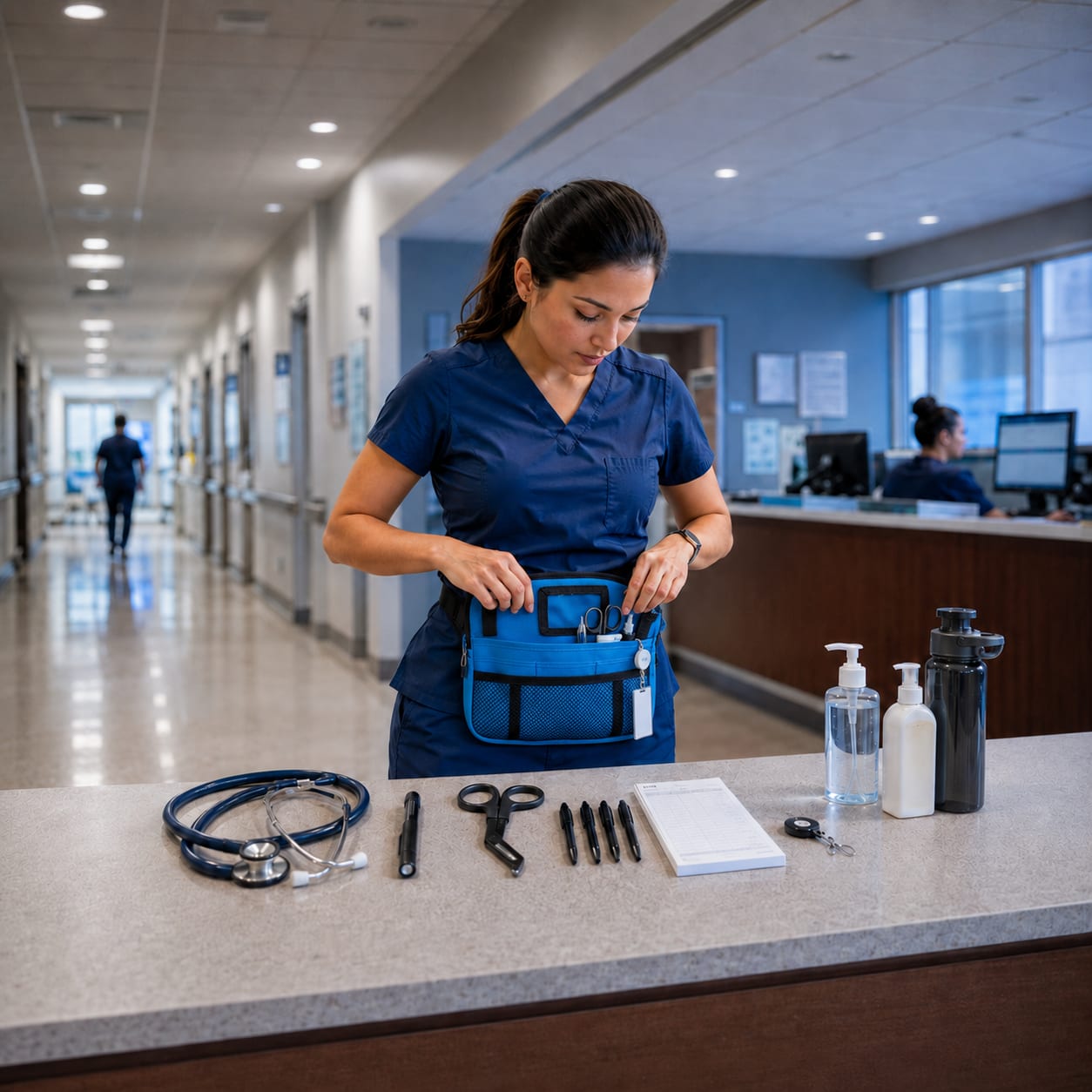
The core argument for a fanny pack in a clinical setting comes down to organization and accessibility. Scrub pants pockets are deep, and scrub top pockets are often inconveniently placed for fast access when you are leaning over a patient. A well-designed fanny pack worn at the waist keeps your most-used items, pens, trauma shears, alcohol wipes, small scissors, tape, within reach without requiring you to dig or shift your posture.
For male nurses working in Labor and Delivery, ICU, or any high-touch unit, the fanny pack also solves the problem of overstuffed pockets pulling your scrub pants down during a shift. If you have ever had to hike up your pants mid-code, you understand why this matters. A fanny pack redistributes the weight of your gear in a way that just makes mechanical sense for people who carry a lot of small items.
The New Grad Nurse's Practical Gear Guide: What You Actually Need (And What You Can Skip) covers the full spectrum of what is worth buying early in your career versus what you can hold off on. The fanny pack consistently makes the worth-it list across specialties and experience levels.
The stigma around fanny packs in clinical settings has largely faded, and that is a good thing. Experienced nurses in the ED, paramedics in the field, and ICU staff running complex equipment setups have been using waist-mounted gear pouches for years because they work. The style conversation is irrelevant when you are managing six patients.
Building Your Actual Gear Kit: What Male Nurses in High-Pressure Units Use
Here is a practical breakdown of what a functional, high-acuity gear setup looks like for male nurses and paramedics who are serious about performance on shift.
- Stethoscope holder: Magnetic or Hook and Loop, depending on your scrub fabric and unit environment. Both options from Bobcat Medical are built specifically for clinical environments, not just marketed there.
- Waist pouch or fanny pack: Carry your pens, shears, tape, alcohol prep pads, and small personal items. Keep your pockets cleaner and your posture better.
- Quality pen light: One that clips securely and does not roll. You will use it more than you expect.
- Compression socks: Non-negotiable for 12-hour standing shifts. Research published through the CDC's NIOSH ergonomics resources consistently identifies prolonged standing as a significant occupational risk factor for lower limb fatigue and musculoskeletal strain. Compression socks are a direct countermeasure.
- Backup badge clip or retractable reel: Badge holders fail at the worst times. Keep a spare in your fanny pack.
- Trauma shears that fit your hand: Sizing matters more than most people realize. If your shears are too small, you will grip harder and fatigue faster during a long cut.
The goal is a kit that does not require you to think about it. Every item has a place. Every place is within reach. You show up at the start of your shift, you gear up in under three minutes, and then you stop thinking about your equipment and start thinking about your patients.
If you want to see what is currently available across all categories, the full Shop All Products page at Bobcat Medical is a good starting point. The product lineup is built around real clinical feedback, not guesswork.
One more thing worth mentioning on the nutrition and energy side: how well your gear serves you on hour ten of a shift is partly about the gear and partly about how well you have fueled your body. What to Eat on a 12-Hour Shift to Stay Sharp is a practical guide that complements the physical gear conversation well.
Frequently Asked Questions About Nursing Accessories for Men
Q: Is a magnetic stethoscope holder safe to use around medical equipment?
Rare-earth magnets used in magnetic stethoscope holders are strong but small. They are generally safe in most clinical environments. However, you should keep any strong magnet away from implanted cardiac devices, certain older infusion pumps, and any equipment with known magnetic sensitivity warnings. If you work in an MRI suite, a magnetic holder is not appropriate for that specific environment. For the vast majority of clinical settings, including ED, ICU, Med-Surg, and Labor and Delivery, a quality magnetic holder presents no meaningful interference risk during normal use.
Q: Will a magnetic stethoscope holder damage my stethoscope?
Quality stethoscopes are not meaningfully affected by the low-field magnets used in stethoscope holders. The internal components of a standard acoustic or electronic stethoscope are not magnetically sensitive in the way that older analog devices might have been. That said, it is always worth checking the manufacturer guidelines for your specific stethoscope model if you have concerns, particularly with high-end electronic models.
Q: Can male nurses wear a nurse fanny pack in professional clinical settings without issue?
Yes, and the adoption rate in high-acuity units has grown significantly over the past several years. Most charge nurses and nurse managers are primarily concerned with infection control compliance, patient safety, and professional appearance, not with whether your organizational tool is a fanny pack versus a cargo pocket. A clean, professional-looking waist pack worn during a shift is widely accepted. Check your unit's dress code policy if you are uncertain, but anecdotally, resistance to clinical fanny packs has largely disappeared in most settings.
Q: What is the best stethoscope holder option for paramedics specifically?
For paramedics, the Hook and Loop Velcro Stethoscope Holder often wins on practicality because it keeps the scope profile flat and tight to the body during movement in tight quarters. In the back of an ambulance or working a scene, a scope that swings or catches on equipment can be a genuine hazard. Magnetic options are also viable, but the flat-hold profile of the Velcro version tends to suit high-mobility prehospital environments particularly well.
Q: Where can I learn more about Bobcat Medical's products and philosophy?
The About Bobcat Medical page covers the brand's background and the clinical thinking behind the product line. The gear is designed by people who understand what high-pressure shifts actually look like, and that context matters when you are deciding what to trust in a demanding work environment.
Ready to upgrade your shift setup? Browse the full product lineup at Bobcat Medical's shop, including the magnetic stethoscope holder, the Hook and Loop Velcro option, and the nurse fanny pack. These are tools built for real shifts by people who take clinical performance seriously. Your gear should work as hard as you do.
Tags
Written by
Bobcat Medical Team
Delivering quality medical equipment and healthcare insights for nurses and healthcare professionals.
Related Articles
The Complete Nurse Hospital Supply List for Every Shift
Every item on this supply list has a clinical reason to be there. From diagnostic tools to wellness gear, this research-backed guide covers what nurses, CNAs, and paramedics actually need on shift.

What to Eat on a 12-Hour Shift to Stay Sharp
Nurse nutrition is a patient safety issue, not just a personal health choice. This research-backed guide covers what to eat before, during, and after a 12-hour shift based on clinical evidence.

The Male Nurse's Guide to Gear That Fits How You Work
Most clinical gear is still designed without male nurses in mind. This research-backed guide covers what carry systems, stethoscope holders, and fanny packs actually work for how male nurses move and work.
Browse Our Medical Equipment
Quality medical equipment at competitive prices. Trusted by clinics and practices nationwide.
Shop Now