The Complete Nurse Hospital Supply List for Every Shift
Every item on this supply list has a clinical reason to be there. From diagnostic tools to wellness gear, this research-backed guide covers what nurses, CNAs, and paramedics actually need on shift.
TL;DR
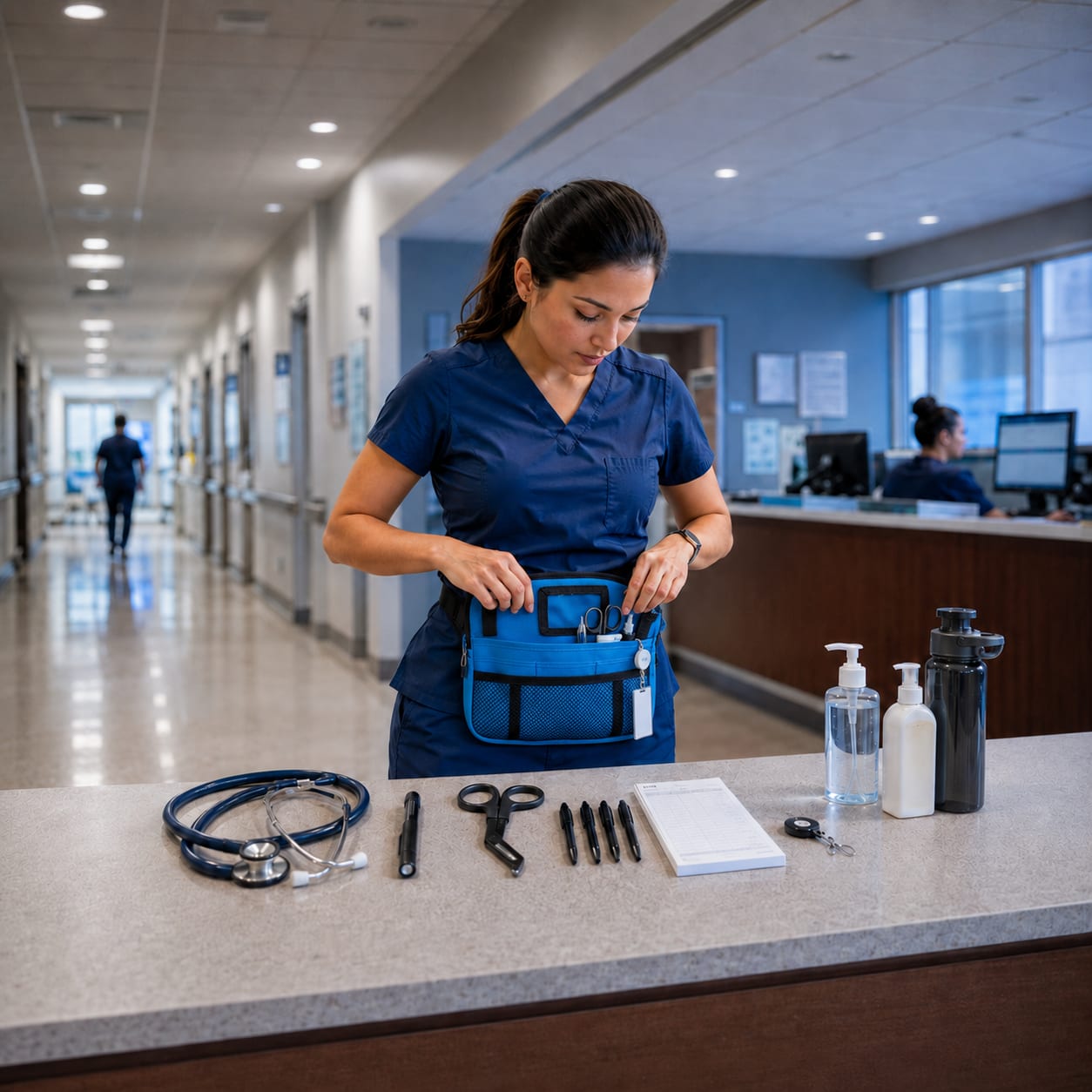
Most nurse supply lists are either too basic to be useful or too long to be practical. This guide takes a different approach: every item is here for a clinical reason, every category is organized by function, and every recommendation is supported by evidence rather than habit. Whether you are a new graduate building your first kit or an experienced nurse recalibrating after a few too many "where did I put that" moments, this is the breakdown that actually matches what clinical work demands.
Why Your Supply List Is a Clinical Document, Not a Shopping List
Every item you carry onto a shift either supports your clinical function or adds noise to it. There is no neutral. A stethoscope without a secure holder becomes a contamination vector and a workflow interruption. A bag with no organizational system becomes a time sink that compounds across a 12-hour shift. Compression socks are not a comfort preference. They are an evidence-based intervention for a documented occupational health risk.
According to the Bureau of Labor Statistics, registered nurses experience musculoskeletal disorders at an incidence rate of 46.0 cases per 10,000 full-time workers, significantly higher than the national average of 29.4 per 10,000. A meta-analysis of 42 studies covering 36,934 nurses published in PMC found that the annual prevalence of work-related musculoskeletal disorders among nurses is 77.2%. Nearly eight in ten nurses experience some form of musculoskeletal issue every single year. The gear you choose, how you carry it, and how well it supports your physical function across a shift are all part of that picture.
This guide organizes your supply list around four functional categories: clinical tools, carry and organization, physical wellness, and unit-specific additions. Every item included has a clinical reason to be there.
Clinical Tools: The Non-Negotiables
These are the items that directly affect your ability to assess, document, and respond. Being without any one of them at a critical moment is not a minor inconvenience. It is a patient safety concern.
Stethoscope
Your stethoscope is your most frequently used diagnostic tool and your most expensive piece of personal clinical equipment. Invest in one that matches your specialty. A quality acoustic stethoscope serves most clinical roles well. Cardiology-focused nurses may benefit from a higher-sensitivity model. Once you have it, store it properly. Draping it around your neck for 12 hours creates cumulative cervical spine and trapezius load that contributes to the musculoskeletal injury rates documented above. Stuffing it in a pocket exposes the diaphragm to contamination and risks tubing damage. A purpose-built holder solves both problems, and we will link you to the right resource for that at the end of this guide.
Penlight
Pupil assessments, throat evaluations, and low-light procedural support all require a reliable penlight. Keep a primary on your person and a backup in your bag. Clinical penlights fail at the worst moments and are the kind of item that disappears from shared supply carts with regularity.
Trauma Shears
Blunt-tip trauma shears are essential for ED, ICU, transport, and any nurse who may need to access a patient through clothing quickly. They cut through denim, leather, and standard hospital gowns without the secondary injury risk of sharp scissors. Keep them accessible, not buried.
Hemostats
A small pair of locking hemostats takes up minimal pocket space and earns its place in wound management, procedural support, and situations where you need to clamp or hold something while a third hand would otherwise be required. Not every nurse needs these daily, but nurses who work in surgical, ED, or procedural settings will reach for them more often than they expect.
Black ink pens, minimum four
Documentation does not stop. Clinical environments consume pens at a rate that defies logic. Bring at least four per shift. Expect to end the shift with two. Gel pens with consistent flow are preferable to ballpoint for carbon-copy forms and documentation under time pressure.
Permanent marker
Labeling IV lines, date-stamping tape, marking specimen bags, and annotating surfaces during procedures all require a permanent marker. It is a small item that is frustrating to be without when you need it.
Notepad or nursing brain sheet
Digital charting is standard in most facilities, but a handwritten brain sheet keeps your patient priorities, pending tasks, and critical values immediately visible without navigating a computer screen. Many experienced nurses maintain both systems simultaneously, using the digital record for formal documentation and the handwritten sheet for real-time shift management.
Watch with a second hand
Counting respirations, timing medication infusions, and assessing pulse rates all require tracking seconds. A dedicated watch is more reliable than a phone screen during clinical work, and it does not require unlocking, switching apps, or worrying about battery life during a critical assessment.
Organization and Carry: The System Behind the Supplies
Having the right supplies only helps if you can find them when you need them. Organization is not an aesthetic preference in clinical settings. It is a functional requirement with direct implications for both efficiency and patient safety.
According to AHRQ's Cognitive Load and Diagnostic Accuracy brief series, last reviewed August 2024, high cognitive load in healthcare providers is associated with increased risk of clinical errors. Every moment spent searching for a supply is a moment of cognitive interruption. Multiply those interruptions across a 12-hour shift and across a career and the cumulative cost becomes significant.
Your organizational zones
Think about your carry system in three functional zones rather than as a collection of individual items:
Zone 1 is your immediate access zone: items you reach for multiple times per hour. Pens, penlight, badge, and a glove supply live here. These should be on your body, accessible within two seconds without searching.
Zone 2 is your frequent access zone: items you need several times per shift but not constantly. Alcohol wipes, trauma shears, tape, your stethoscope, and a small notepad belong here. A waist-worn carry system handles this zone better than scrub pockets alone.
Zone 3 is your workstation or bag zone: backup supplies, food, personal items, and anything you do not need during active patient care. These stay at your station or in your locker.
Most organizational failures happen because nurses run everything from Zone 1, stuffing Zone 2 and Zone 3 items into pockets that were designed to hold a notepad and a pen. The result is the bulging, mismatched, constantly reorganized pocket situation that adds friction to every shift.
Nursing bag or backpack
Your main bag should have a waterproof lining, dedicated compartments that keep food separate from clinical supplies, and enough structure to maintain organization across a 12-hour shift. A bag that dumps everything into a single cavity is a system failure waiting to happen.
Badge reel with breakaway clip
Your badge is swiped dozens of times per shift. A retractable reel keeps it accessible without requiring you to hold it or fumble with a clip. The breakaway safety release is important, not optional, particularly in settings where patients may grab lanyards or cords.
Insulated food container
Your break may be 20 minutes and may come at hour six. Having food ready, appropriately stored, and easy to access in that window is the difference between eating and not eating. As covered in our companion blog on shift nutrition, eating during shifts directly affects cognitive performance and clinical error rates. An insulated container is not a comfort item. It is a performance tool.
Physical Wellness Gear: What Keeps You Functional Through Hour Twelve
The clinical supplies above keep your patients safe. The wellness supplies below keep you functional enough to use them properly through the full length of your shift.
Supportive footwear
Bedside nurses spend 80 to 90 percent of a 12-hour shift on their feet, walking approximately 4 to 5 miles per shift, according to research cited by STAND+ citing BMC Musculoskeletal Disorders. The same source notes that prolonged occupational standing carries a 1.7-fold increased risk for foot pain compared to non-standing work. A 2025 peer-reviewed study published in PMC confirmed that foot health disorders from prolonged standing are common among nursing populations beginning in student clinical placements, suggesting the cumulative damage starts early.
What the research supports in footwear for clinical settings includes a well-cushioned midsole for shock absorption during prolonged walking and standing, lateral stability that prevents the micromovement compensation that accelerates foot fatigue, ASTM-certified slip resistance for wet clinical surfaces, and a fit that accommodates natural toe splay for balance and stability. Footwear recognized by the American Podiatric Medical Association for promoting foot health, such as Dansko clogs, carries an evidence-backed endorsement that generic consumer shoes do not.
Compression socks
Compression socks are among the most evidence-supported wellness interventions available to clinical nurses. A prospective crossover clinical trial published in PMC in 2022, conducted specifically on workers with prolonged standing occupations including healthcare workers, found that compression stockings significantly reduced leg edema and pain compared to the control condition. As documented by Nurse.com's clinical review of compression hosiery, compression socks combat fatigue by delivering more oxygen to working muscles and preventing lactic acid accumulation, a byproduct of muscle exertion that directly contributes to the soreness and heaviness nurses experience in the second half of a shift.
The recommended compression level for most nurses is 15 to 20 mmHg, which provides meaningful circulatory support without being restrictive during active clinical work. Nurses who already experience significant swelling, visible spider veins, or heavy legs by end of shift should consider 20 to 30 mmHg compression after consulting with a healthcare provider. Knee-high or over-the-calf length provides the most benefit because it covers the full area affected by gravitational blood pooling during prolonged standing.
Personal hand sanitizer
This is one of the clearest cases where individual carry produces a measurably better patient safety outcome than relying on shared infrastructure. Research presented at the American Society of Anesthesiologists annual meeting and confirmed by Infection Control Today found that healthcare workers given a personal belt-worn sanitizer dispenser were nearly 30 percent more likely to comply with hand hygiene protocols compared to those relying on wall-mounted dispensers alone. The CDC's hand hygiene clinical safety guidance recommends alcohol-based hand sanitizer containing at least 60% alcohol as the preferred hand hygiene method in most clinical situations when hands are not visibly soiled. Keeping your own supply on your person removes the barrier of distance between you and compliance.
Hand lotion
Frequent handwashing and alcohol-based sanitizer use damages the skin barrier over time, producing dryness, cracking, and discomfort that compounds across consecutive shifts. A small tube of fast-absorbing, fragrance-free lotion in your pocket is a practical countermeasure. Cracked skin on hands also presents an infection control consideration, as compromised skin barrier integrity increases pathogen transmission risk for both nurse and patient.
Hydration bottle with time markings
As detailed in our nutrition blog, 36% of nurses and doctors were dehydrated at the start of their shifts and 45% at the end, according to the HANDS on prospective cohort study published in PubMed. Dehydration of as little as 2% of total body weight impairs both physical and cognitive performance. A water bottle with time-based volume targets visible throughout the shift provides an objective hydration prompt that does not depend on thirst, which is not a reliable early indicator of dehydration.
High-protein snacks
Stable blood sugar across a shift directly affects cognitive performance and clinical error rates. As covered in our shift nutrition blog, small and frequent eating outperforms large infrequent meals for sustained alertness. Practical, portable, protein-forward options such as nuts, protein bars with low added sugar, Greek yogurt portions, or tuna pouches give you a Zone 3 supply that supports performance without requiring sit-down meal time.
Stain remover pen
A single pen can save a set of scrubs from a bodily fluid incident mid-shift. This is a small and inexpensive item with a disproportionate return on investment in clinical environments where exposure to fluids is a routine occupational reality.
Unit-Specific Add-Ons Worth Considering
The supplies above represent a universal clinical baseline. What follows is a practical breakdown of additions that experienced nurses in specific settings have found worth the pocket space.
Emergency Department and Trauma
Speed and access are the priority. Keep trauma shears immediately accessible rather than buried. A small personal flashlight for situations where overhead lighting is not available or appropriate adds genuine utility in trauma bays. A tourniquet in your carry is worth considering for nurses in high-trauma volume environments. The pace of emergency care means that every item on your body needs to be retrievable without deliberate thought.
ICU
Documentation density and precision assessment are the defining demands of ICU nursing. A printed hemodynamics reference card, a medication calculation reference, and extra alcohol wipes for frequent equipment cleaning are practical additions for nurses managing complex, multi-system patients with extensive IV lines and monitoring requirements.
Med-Surg and General Inpatient
High patient volume and constant movement between rooms make organizational efficiency the most critical variable. Nurses managing five to seven patients simultaneously benefit most from a carry system that keeps everything consistently located. Running out of a basic supply mid-assessment because your bag is disorganized costs time that multiplies significantly across a high-census shift.
Labor and Delivery
Shifts in Labor and Delivery can transition from slow to extremely high intensity with very little warning. A personal thermometer eliminates the search for a shared unit thermometer during rapid assessments. Ear protection is a practical and often overlooked addition for nurses working in environments with sustained high noise levels during active deliveries.
Paramedics and Transport Nurses
Portability and redundancy are the priorities in field environments. Duplicate supplies of clinical essentials protect against the loss or contamination that occurs in non-controlled outdoor settings. A compact, well-secured carry system that does not shift during vehicle transport or active patient handling is worth prioritizing over a system that works well only in stationary environments.
CNAs and Patient Care Technicians
The physical demands on CNAs are comparable to or exceed those of RNs in terms of direct patient handling, repositioning, and transfer work. Compression socks and supportive footwear are especially important for this role. Personal hand sanitizer and glove accessibility are equally critical given the frequency of direct patient contact.
At Bobcat Medical, built by medical professionals for medical professionals, we believe that being well-equipped for a shift is not about having more gear. It is about having the right gear, organized so that your hands, your mind, and your workflow can stay focused on your patients. If you are still sorting out your stethoscope storage or looking for a carry system that actually works with how you move, our stethoscope holder and nurse fanny pack options are worth a look.
Frequently Asked Questions
Q: What is the single most overlooked item on a nurse supply list?
A: Personal hand sanitizer and compression socks are consistently cited by experienced nurses as the items they wish they had prioritized from the beginning of their careers. Clinical essentials receive attention during training. Personal wellness supplies are treated as optional until the consequences of ignoring them become impossible to ignore. The research is clear on both: personal hand sanitizer increases compliance with hand hygiene protocols by nearly 30%, and compression stockings have clinical trial support for reducing leg edema and fatigue in prolonged-standing occupations.
Q: How do I keep my supplies organized consistently across different scrub sets?
A: Organize by item category rather than by pocket label. Decide what type of item lives where: writing tools in one location, small assessment tools in another, and high-frequency clinical supplies in your Zone 2 carry system. Apply that logic across every pair of scrubs you own. When you switch to a new scrub set with different pocket configurations, remap using the same category rules rather than starting over. The consistency of location is what builds the muscle memory that makes retrieval automatic rather than cognitive.
Q: What compression level should I look for in compression socks?
A: For most nurses without pre-existing circulatory symptoms, 15 to 20 mmHg provides meaningful support without being restrictive during active clinical work. Nurses who already experience significant end-of-shift swelling, heaviness, or visible vein changes should consider 20 to 30 mmHg after consulting with a healthcare provider. The PMC crossover clinical trial on compression stockings specifically studied workers in prolonged-standing occupations and found compression stockings reduced both edema and pain. Knee-high length is preferable to ankle-height for nurses because it addresses the full anatomical area affected by gravitational blood pooling.
Q: What should new graduate nurses prioritize buying first?
A: Start with the clinical non-negotiables: a quality stethoscope with a proper holder, trauma shears, a penlight, and supportive footwear with compression socks. Build the rest of your kit over your first few months as you learn what your specific unit actually demands. Spending everything at once before you understand your workflow is one of the most common and avoidable new-grad spending mistakes. Our companion blog, The New Grad Nurse's Practical Gear Guide, covers exactly how to build your kit over time without overspending early.
Q: How often should I restock and audit my clinical kit?
A: The most effective approach is to restock at the end of each shift rather than the beginning. Ending a shift by restoring your kit to its baseline state means you start the next shift fully prepared rather than discovering mid-shift that you are out of alcohol wipes or down to one pen. A quick audit at the start of each shift, taking less than 60 seconds, confirms that everything is where it should be before the clinical demands of the day begin.
Written by Bobcat Medical Team Delivering quality medical equipment and healthcare insights for nurses and healthcare professionals.
Tags
Written by
Bobcat Medical Team
Delivering quality medical equipment and healthcare insights for nurses and healthcare professionals.
Related Articles
What to Eat on a 12-Hour Shift to Stay Sharp
Nurse nutrition is a patient safety issue, not just a personal health choice. This research-backed guide covers what to eat before, during, and after a 12-hour shift based on clinical evidence.
Best Nurse Graduation Gifts 2026: Magnetic Stethoscope Holder & More
Discover the best nurse graduation gifts for 2026, from magnetic stethoscope holders to nurse fanny packs, practical gear for every clinical specialty.
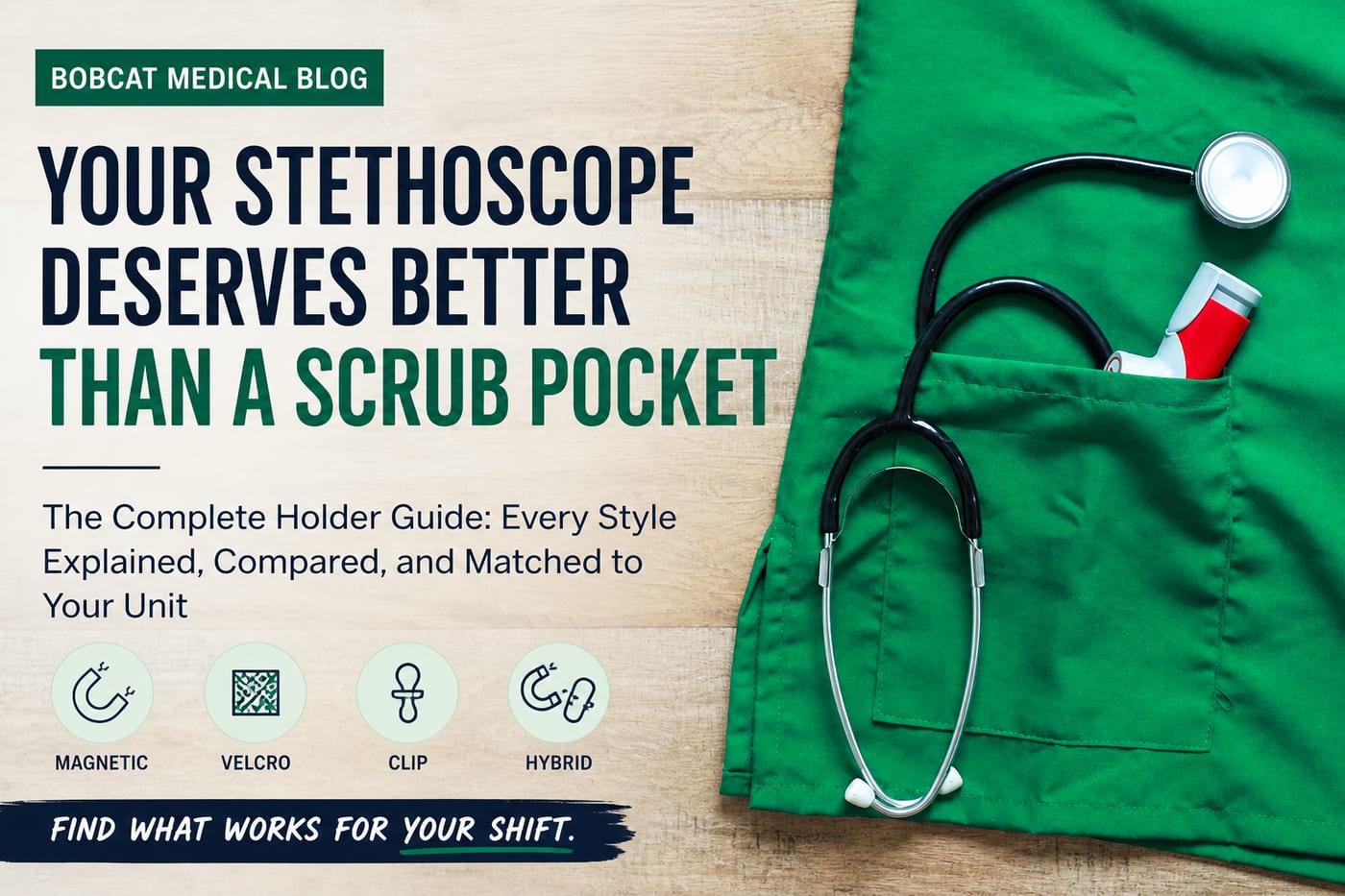
Magnetic & Velcro Stethoscope Holders: A Guide for Medical Professionals
Stop guessing which stethoscope holder is right for you. This guide compares every major holder style with honest tradeoffs and a role-by-role breakdown for clinicians.
Browse Our Medical Equipment
Quality medical equipment at competitive prices. Trusted by clinics and practices nationwide.
Shop Now