The Male Nurse's Guide to Gear That Fits How You Work
Most clinical gear is still designed without male nurses in mind. This research-backed guide covers what carry systems, stethoscope holders, and fanny packs actually work for how male nurses move and work.

TL;DR
Male nurses now represent 11.2% of the RN workforce in the United States, up from 8% in 2015, and that number is growing. But the clinical accessory market has been slow to catch up. Most gear is still designed around smaller frames, smaller pockets, and different movement patterns. This guide covers what workflow-optimized carry actually looks like for male nurses doing 12-hour shifts in the ED, ICU, Med-Surg, and everywhere in between, including why your current setup may be working against you, what the research says about musculoskeletal injury in nursing, and which gear changes produce the most meaningful improvement.
The Gear Gap Nobody Talks About in Nursing
You show up to your shift with a Littmann draped around your neck, pockets already stuffed with pens, trauma shears, a penlight, and two alcohol wipes you grabbed on the way in. Within the first hour, your stethoscope has snagged on a bed rail, nearly pulled your collar during a patient transfer, and somehow ended up in the wrong pocket. Sound familiar?
Here is something worth acknowledging upfront: nursing has historically been marketed as a female profession, and the accessory market reflects that. Most gear is designed with smaller frames, smaller pockets, and smaller carry systems in mind. According to the 2024 National Nursing Workforce Study conducted by NCSBN, male nurses now represent 11.2% of the RN workforce in the United States, up from 8% in 2015. That is a meaningful and growing segment of the healthcare workforce, and they deserve gear that actually fits how they work.
This blog is for the guys in scrubs doing 12-hour shifts in demanding clinical environments. Not a list of products designed for someone else and rebranded, but a practical look at carry systems built around the physical reality of how male nurses move, lift, transfer, and assess.
Why Your Current Setup Is Working Against You
Most male nurses carry more gear per shift than their scrub pockets were ever designed to hold. The result is a constant juggling act that adds up to real physical wear over time, and the research on this is unambiguous.
A meta-analysis of 42 studies covering 36,934 nurses published in PMC found that the annual prevalence of work-related musculoskeletal disorders among nurses is 77.2%. That is not a rounding error. Nearly 8 in 10 nurses deal with some form of musculoskeletal issue every single year. As further cited in NCBI StatPearls, healthcare professionals are 5 times more likely to sustain a musculoskeletal injury compared to workers in other fields.
The CDC NIOSH healthcare ergonomics program identifies manual patient handling and sustained awkward postures as leading contributors to musculoskeletal disorders among healthcare workers. How gear is carried throughout a shift is a direct and modifiable contributor to that postural load.
Carrying your stethoscope around your neck all day is a good example of a small habit with a large cumulative cost. A Littmann Cardiology IV weighs 177 grams (6.2 oz) according to 3M's official specifications. That does not sound significant until you factor in 12 hours of bending, lifting, and leaning with that consistent downward pull on the cervical spine and upper trapezius muscles. And as formally noted in Welch Allyn's official stethoscope product documentation, stethoscope hoses can also be a strangulation hazard in settings where patient behavior is unpredictable. For male nurses doing high-contact patient care including transfers, repositioning, and hands-on assessment, that risk is real and documented.
Overstuffed scrub pockets create a different but equally cumulative problem. Uneven weight distribution from loading a single pocket creates lateral postural compensation that accumulates across a shift in ways that are easy to dismiss in the short term and expensive to ignore over a career.
The Magnetic Stethoscope Holder: Why It Works for Male Nurses
A magnetic stethoscope holder clips directly to your scrub top and uses strong magnets to hold your stethoscope securely without loops, clasps, or tangles. You grab it, you use it, you place it back. The motion is clean, fast, and one-handed.
For male nurses specifically, this matters for reasons beyond simple convenience.
First, male clinicians tend to have more upper body engagement during patient care. Transfers, repositioning, assists, and hands-on assessment all involve more torso rotation and reach than lower-acuity interactions. A stethoscope hanging from your neck during those moments is a liability, not a convenience. It catches, it pulls, and it gets in the way at exactly the moments when you cannot afford distraction.
Second, many male nurses favor carry systems that stay out of the way, do the job without fuss, and do not require management between tasks. A magnetic stethoscope holder fits that preference naturally. It is low-profile, one-motion, and silent. You wear it and it disappears into your workflow until you need it.
Third, the physical proportions of many male nurses, specifically longer torso length and broader shoulder width, change where a neck-worn stethoscope actually sits and how much it swings during movement. A magnetic holder positioned at the chest or collar area stays geometrically closer to the body and moves with the torso rather than independently from it.
For nurses working in the ED or ICU where speed of access is a clinical consideration, the one-handed magnetic release is a meaningful advantage over adjusting a neck drape or digging through a pocket. You need your stethoscope in your hand before you finish walking to the bedside.
One important consideration: nurses who personally have implanted cardiac devices such as pacemakers or ICDs should consult their cardiologist before using a magnetic holder positioned near the chest. See the FAQ section below for complete guidance on this.
The Nurse Fanny Pack: Function Over Reputation
The fanny pack has a reputation problem in some circles. Walk into any busy ED or ICU and you will find experienced male nurses wearing them without apology, because function wins every argument that fashion tries to start.
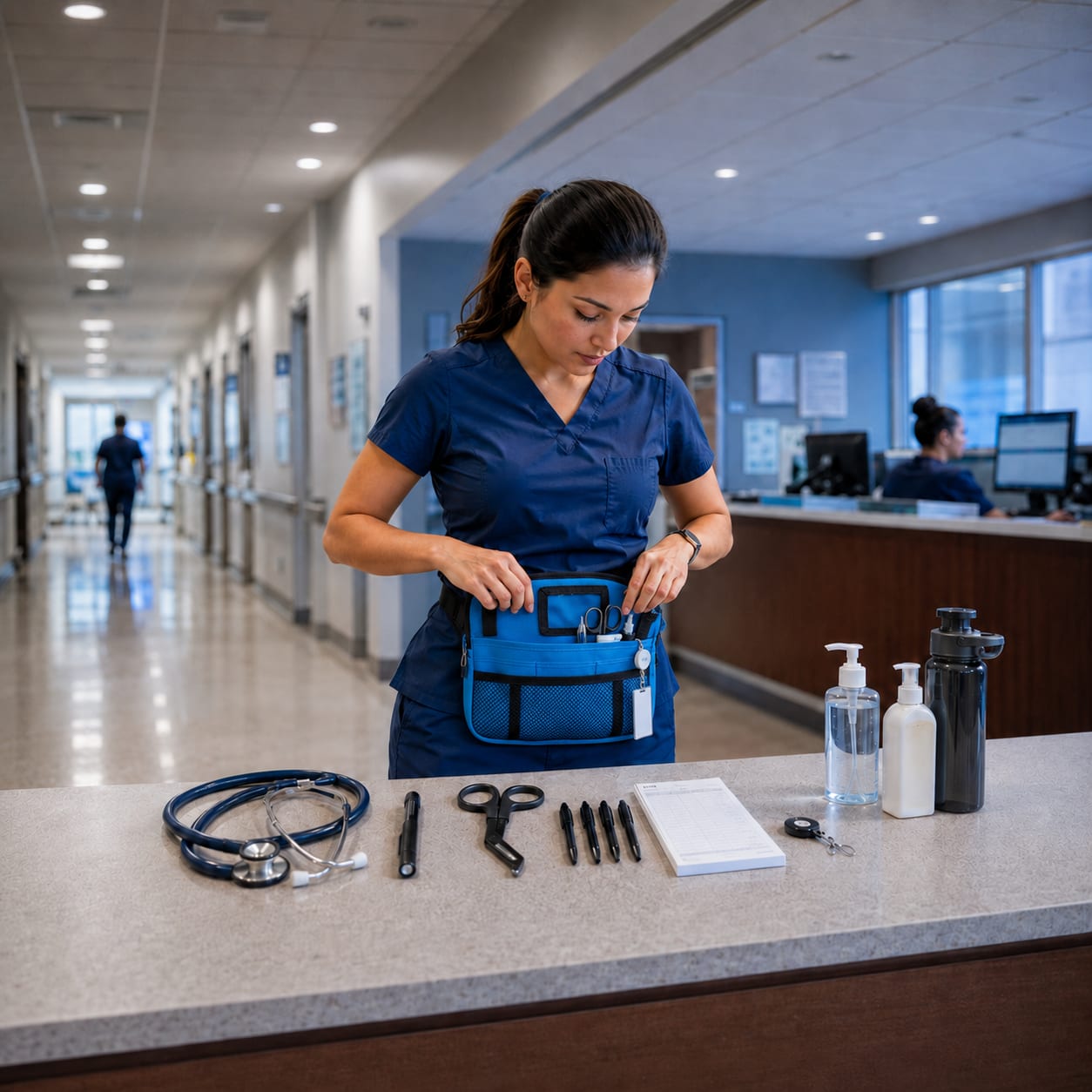
A nurse fanny pack solves the cargo problem that scrub pockets never fully address. Trauma shears, a penlight, alcohol prep pads, gloves, a small notepad, your badge, and enough room for a snack by hour six. Everything is at hip level, accessible with one hand, and not dragging your waistband down all shift.
Here is why this carry system works particularly well for male nurses:
- Hip-level access: Male nurses tend to have longer torso proportions, which makes hip-level carry more natural and ergonomically neutral than reaching across the body into a chest or thigh pocket repeatedly across a shift.
- Weight distribution: Spreading gear across your waist reduces the one-sided loading that comes from stuffing everything into a single scrub pocket. Even load distribution is a basic ergonomic principle with direct musculoskeletal implications across a long shift.
- No interference during patient contact: A fanny pack worn at the hip stays clear when you lean in for an assessment, assist with a transfer, or reach across a patient. Chest and neck carry do not offer that clearance.
- Durable and washable: A quality clinical fanny pack handles the same daily abuse as your scrubs. End of shift, it goes in the wash.
- Combined carry system: Many male nurses use a fanny pack alongside a stethoscope holder as a complete system. Stethoscope at the chest via the holder, supplies at the hip via the pack. Everything has a consistent, predictable home.
According to AHRQ's Cognitive Load and Diagnostic Accuracy brief series, high cognitive load in healthcare providers is associated with increased risk of clinical errors. Knowing exactly where every piece of gear is without searching is a meaningful reduction in the extraneous cognitive load that competes with clinical decision-making throughout a demanding shift. That is not a soft benefit. It is a patient safety consideration.
Ergonomics as a Career Strategy, Not Just a Comfort Preference
If you have been in nursing for more than two years, you already know someone who left the bedside earlier than planned because of a back injury, a shoulder issue, or chronic neck pain. These are not random events. They are predictable outcomes of carrying gear poorly and moving through patient care without adequate ergonomic support, repeated thousands of times over a career.
As Nevada State University's School of Nursing notes, the nursing shortage crisis continues to loom, and ergonomics can play a key role in reducing its impact by increasing nurse retention rates. Healthcare facilities that prioritize ergonomics can reduce the physical strain of the job, lower the risk of burnout, and improve retention overall. Keeping nurses healthy and at the bedside longer is not just a personal win. It is a systemic one.
Small decisions compound over time. Using a magnetic holder instead of neck carry reduces repetitive cervical spine loading. Using a fanny pack instead of overstuffed pockets improves postural symmetry and weight distribution. Neither change is a complete solution to the physical demands of nursing, but both are measurable improvements when applied consistently across a career. The meta-analysis published in PMC found that the most commonly affected body regions for nurse musculoskeletal disorders are the lower back, neck, and shoulders. These are precisely the regions most affected by how stethoscopes are carried and how gear is distributed across the body during a shift.
The gear choices you make today are part of your long-term career strategy. Not just a shift-by-shift convenience decision.
Building a Carry System That Works for Your Shift
The goal is a complete system, not a collection of random accessories. Here is how male nurses in high-acuity settings tend to build their carry setup effectively:
Anchor your stethoscope first. Use a magnetic stethoscope holder or a hook and loop velcro holder depending on your scrub fabric and unit environment. Magnetic works best on most standard scrub fabric and gives you the fastest one-handed access. Velcro is a solid choice for thicker fabrics, personal preference, or units with magnetic restrictions.
Centralize your supplies at the hip. Move high-frequency items including gloves, prep pads, pens, and a small notepad to a nurse fanny pack worn at the waist. This clears your scrub pockets for unit-specific items like report sheets or pharmacy labels and creates a consistent, predictable carry system across every shift.
Think about badge placement. Position your badge reel in logical proximity to your stethoscope holder so you are not crossing your arms to scan in or reaching awkwardly across your body between tasks. Small proximities save seconds that add up across a 12-hour shift.
Audit your carry every few shifts. If you are not reaching for something regularly, remove it from your daily carry. Dead weight is still weight, and every item you carry without using is a postural load that compounds over time without a clinical return.
Match your system to your unit. ED nurses carry differently from ICU nurses. ICU may need more documentation depth and documentation tools close at hand. ED needs speed and immediate access above all else. Your system should reflect your actual workflow, not a generic template.
At Bobcat Medical, built by medical professionals for medical professionals, we believe that real-shift gear is gear designed around what clinical work actually looks like, not what it looks like in a product photo. That philosophy applies equally to male nurses, female nurses, CNAs, paramedics, and every other healthcare professional doing this work every day.
Frequently Asked Questions
Q: Is a magnetic stethoscope holder safe to use around patients with pacemakers or implanted cardiac devices?
A: This is an important question that every nurse should understand clearly. For most standard hospital equipment, magnetic stethoscope holders do not pose a documented interference risk in routine clinical use. However, the American Heart Association clearly states that magnetic fields can interfere with implanted cardiac devices such as pacemakers and ICDs. A 2025 study published in Circulation: Arrhythmia and Electrophysiology reinforced that patients with cardiac implantable electronic devices should keep all items generating a magnetic field several inches away from those devices. In practical terms this means two things: if you personally have an implanted cardiac device, consult your cardiologist before using a magnetic holder positioned near your chest; and when performing close physical assessments on patients with pacemakers or ICDs, be mindful of proximity. For cardiac monitoring units, cath labs, or MRI-adjacent environments, a hook and loop holder is the appropriate choice. Always follow your facility's specific policies on magnetic accessories.
Q: Do nurse fanny packs look unprofessional in a hospital setting?
A: The perception of fanny packs in clinical settings has shifted significantly over the past several years, largely because nurses themselves normalized them by demonstrating their practical value. Most patients do not notice or care what you are wearing at your waist. They care whether you can respond quickly and have what you need when you need it. Experienced male nurses consistently report that a well-organized fanny pack makes them faster, more organized, and more confident, which reads as professional in any clinical environment. If your facility has a strict appearance policy, a slim, neutral-colored pack worn neatly at the front of the waist tends to pass without issue.
Q: What is the difference between a magnetic holder and a hook and loop velcro stethoscope holder?
A: Magnetic holders use opposing magnets to hold the stethoscope and release with a single one-handed pull. Hook and loop velcro holders use interlocking fabric fasteners that provide a very firm mechanical grip and require a slightly more deliberate motion to release. Magnetic tends to be faster for high-frequency access and operates silently, which matters in quiet patient rooms. Velcro is a better choice for thicker scrub fabrics, personal preference for a firmer hold, or environments where magnetic accessories are restricted. Both are significantly better than neck carry or pocket storage for daily clinical use.
Q: Are these carry systems useful for CNAs, paramedics, and LVNs, or just RNs?
A: The ergonomic principles and workflow benefits apply equally across roles. CNAs, paramedics, LVNs, and any healthcare professional carrying a stethoscope and needing organized supply access will benefit from the same carry approach. The musculoskeletal injury data covers nurses broadly, not just RNs, and the cognitive load research on organized gear applies to any clinician working under sustained clinical pressure. Workflow efficiency and physical health protection are not credential-specific concerns.
Q: How long should a quality stethoscope holder last under daily clinical use?
A: A well-made holder used daily across 12-hour shifts should last at least 12 to 18 months before showing meaningful wear, and many last considerably longer with regular cleaning and inspection. Magnetic holders tend to have the longest functional lifespan since there are no mechanical wearing parts. Hook and loop holders benefit from regular cleaning of the hook surface with a stiff brush to maintain grip strength. Replace any holder that no longer secures your scope reliably during normal clinical movement. A failing holder is worse than no holder at all, because it creates false security that can end with your scope on the floor at a critical moment.
Written by Bobcat Medical Team Delivering quality medical equipment and healthcare insights for nurses and healthcare professionals.
Tags
Written by
Bobcat Medical Team
Delivering quality medical equipment and healthcare insights for nurses and healthcare professionals.
Related Articles

Magnetic Stethoscope Holder: Nursing Accessories for Men That Work
Male nurses need gear that keeps up with real shifts. Here's what actually works in high-pressure units, from magnetic stethoscope holders to nurse fanny packs.
The Complete Nurse Hospital Supply List for Every Shift
Every item on this supply list has a clinical reason to be there. From diagnostic tools to wellness gear, this research-backed guide covers what nurses, CNAs, and paramedics actually need on shift.

What to Eat on a 12-Hour Shift to Stay Sharp
Nurse nutrition is a patient safety issue, not just a personal health choice. This research-backed guide covers what to eat before, during, and after a 12-hour shift based on clinical evidence.
Browse Our Medical Equipment
Quality medical equipment at competitive prices. Trusted by clinics and practices nationwide.
Shop Now