The New Grad Nurse's Practical Gear Guide: What You Actually Need (And What You Can Skip)
New nurse? Cut through the gear hype. This practical guide covers the real essentials, smart buys, and what to skip so you can invest wisely from your very first shift.

TL;DR New graduate nurses are bombarded with gear advice, most of it expensive, some of it unnecessary, and occasionally inaccurate. What you actually need for your first year of nursing comes down to five non-negotiables: a reliable stethoscope with a proper holder, supportive footwear, a watch with a second hand, quality pens, and an organized way to carry your essentials. Everything else is context-dependent and best purchased after you have worked a few shifts and know what your unit actually demands. This guide gives you the honest, research-backed breakdown so you can invest wisely from day one.
The Reality Check: What New Nurses Actually Need
You have passed your boards. You have your license. Now you are standing in your first shift, and that orientation checklist feels about as useful as a pen that has run out of ink. The truth is, nursing school did not prepare you for one crucial skill: figuring out which gear actually matters on a real shift and which is just noise.
The average new graduate nurse receives mixed and often overwhelming advice about what to buy before day one. Some of it comes from well-meaning colleagues who swear by obscure gadgets. Some of it comes from marketing that promises to revolutionize your shift. What actually works is straightforward: real gear for real shifts, built around the problems you will actually encounter during a 12-hour day on the floor.
This guide cuts through the clutter. If you are a new nurse graduate or anyone pivoting into healthcare, this is the practical breakdown you have been looking for.
The Non-Negotiables: Gear That Every New Nurse Needs
These are not luxury items. These are the things that will keep you functional, safe, and effective when you are six hours into a demanding shift with no sign of slowing down.
A reliable stethoscope with secure storage
Your stethoscope is one of your most-used diagnostic tools, and a stethoscope that is constantly tangling around your neck, disappearing into your locker, or getting damaged from being dropped is a liability. Investing in a proper stethoscope holder is non-negotiable. Whether you choose a magnetic holder, a hook and loop velcro option, or a quality clip-style holder, the goal is the same: your most critical diagnostic tool stays accessible, secure, and protected throughout your shift.
Compression socks and supportive footwear
You will be on your feet for 12 hours or more. This is not a comfort preference. It is injury prevention. According to the Bureau of Labor Statistics, registered nurses experience musculoskeletal disorders at an incidence rate of 46.0 cases per 10,000 full-time workers, significantly greater than the national average of 29.4 cases per 10,000 workers across all occupations. Research published in PMC citing BLS occupational data confirms that injury and illness rates for nurses rank among the highest across all occupations, including most manufacturing, construction, and agricultural sectors. Invest in quality shoes and compression socks from day one.
A watch with a second hand or a reliable timer
Counting respirations, assessing pulse rates, timing medication administration. You will need to track seconds multiple times every shift. A simple, durable watch is more reliable than a cracked phone screen and more practical than fumbling for your device mid-assessment.
Pens that actually work
Buy good ones. Cheap pens skip, bleed through paperwork, and die mid-shift at the worst possible moments. Keep at least two quality pens on you at all times. This is not the place to save three dollars.
An organized carry solution for your essentials
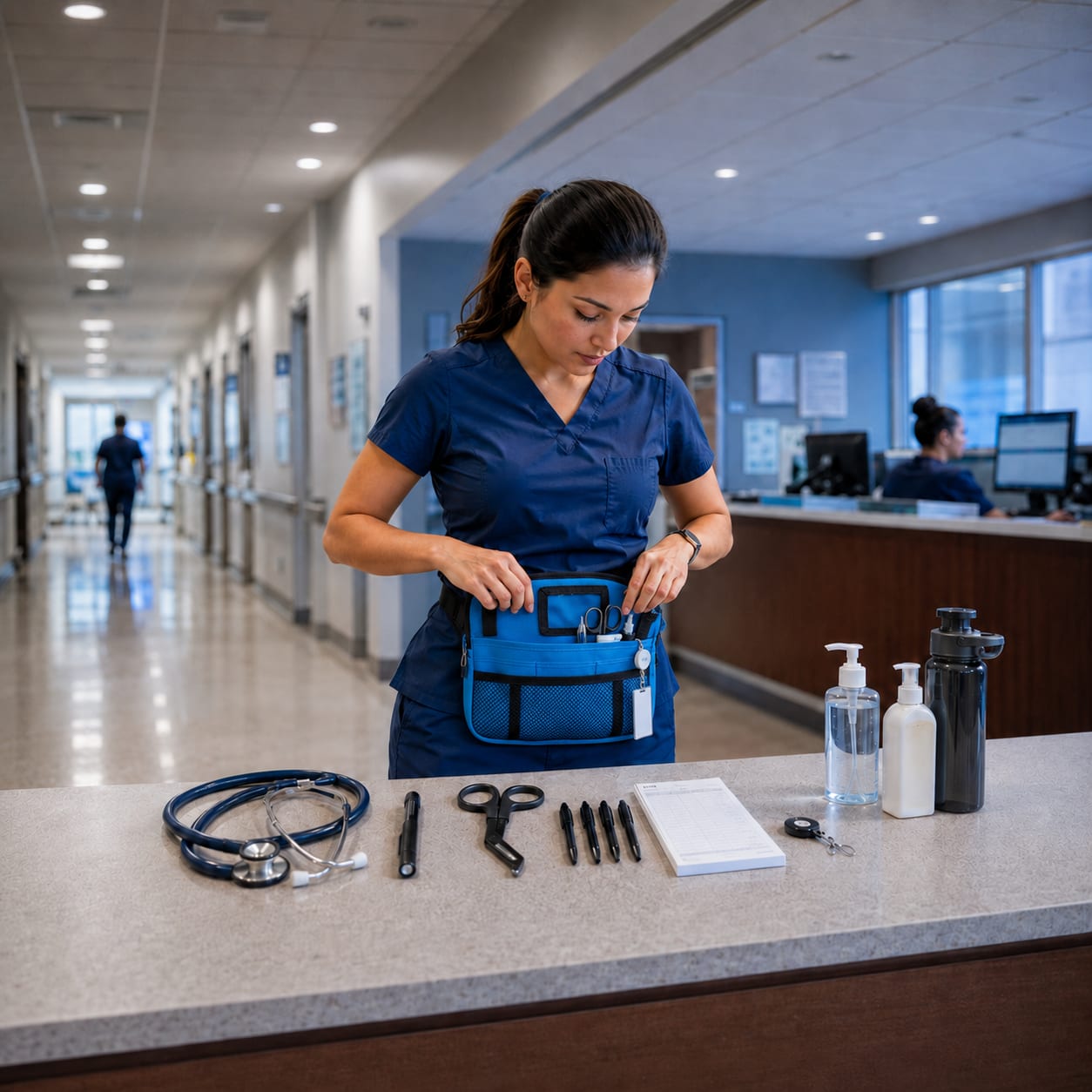
Your scrubs pockets are not enough. You need a reliable, organized way to carry supplies, your phone, keys, and the random items that accumulate during a shift. A purpose-built nurse fanny pack or structured bag with multiple compartments and a secure closure keeps your essentials accessible without the chaos of overflowing pockets.
These five categories are non-negotiable. Everything else depends on your unit, your specialty, and what you discover you actually need after a few weeks on the floor.
The Nice-to-Haves: Gear That Genuinely Improves Your Shift
Once you have covered the basics, there are several items that can make your shift meaningfully easier. The key distinction is that these solve real problems you have actually encountered, not hypothetical ones you read about on a forum.
A stethoscope holder matched to your unit
Different clinical environments have different demands, and the right holder varies accordingly. Magnetic stethoscope holders offer silent, quick-access storage and work well in settings where speed and quiet matter, such as the ICU or acute care units. Hook and loop velcro holders provide a stronger, more secure grip and are well-suited to high-movement roles where you need confidence that your scope will not move no matter how much you do. Clip-style holders are lightweight, low-maintenance, and work well in lower-acuity or outpatient settings where you are less likely to be in constant vigorous motion. The best holder is the one that works in your specific environment, on every shift, without requiring you to think about it.
Moisture-wicking undershirts or scrub liners
Hospitals run warm, and nurses run warmer. A breathable layer underneath your scrubs keeps you comfortable and prevents the soaked-through situation that sets in around hour five of a fast-moving shift.
A small notebook or reliable note-taking method
Some nurses find a physical notebook essential for quick brain dumps between patients, tracking to-do items during rounds, and keeping report organized. Others use their phones. Find your system during your first few weeks and stick with it. Clean notes lead to cleaner charting and sharper handoff reports.
Backup pens and a spare holder
Once you have identified a stethoscope holder that works for your unit, keeping a spare in your locker is a small investment that prevents a genuinely frustrating situation when your primary one needs cleaning or gets misplaced.
What You Can Skip and Why
This is the permission slip many new nurses need. You do not have to buy everything.
Designer scrubs
Buy comfortable, durable scrubs that fit your body well and allow you to move freely. Beyond fit and function, brand does not matter. Your patients do not care. Your back cares that the scrubs move with you during patient care. That is where the evaluation ends.
Excessive specialty bags or organizers
One well-made, versatile carry solution beats three mediocre specialty bags for different scenarios. Resist the urge to buy an item for every hypothetical situation before you know which situations actually apply to your unit.
Gadgets marketed as solutions to fatigue or burnout
Specialty compression sleeves, aromatherapy diffusers for your locker, and similar products are pleasant but they are not clinical solutions to systemic problems. The real contributors to nurse fatigue are shift length, staffing ratios, and workload. Do not spend money trying to treat structural problems with accessories.
The cheapest version of essential items
There is a meaningful difference between expensive and well-made. Buy the middle ground. A quality stethoscope holder that lasts two years is a better investment than a cheap one that breaks in two months or a premium version with features you will never use on your unit.
Anything that complicates your routine
If a piece of gear requires special care, special cleaning procedures, or a learning curve to use mid-shift, it probably will not survive the reality of your actual work environment. Stick with durable, simple, and washable.
Common New Grad Spending Mistakes and How to Avoid Them
New nurses are excited, nervous, and eager to walk in looking prepared. This is also the exact mindset that leads to spending several hundred dollars on gear that ends up unused. Here is what to watch out for.
Buying everything before you start
You do not know your actual needs yet. Get the true essentials before day one. Most secondary purchases should wait until you have worked several shifts and understand what your unit demands and what you genuinely miss having. This prevents duplicate purchases and items that do not fit your workflow.
Taking advice from one experienced nurse as universal truth
One person's essential is another person's unnecessary expense. A nurse who has worked the ICU for ten years has different needs from a labor and delivery nurse in their first month. Listen to advice from multiple colleagues on your specific unit, and filter it through your own experience as you accumulate it.
Assuming price equals quality
A more expensive bag is not automatically a better bag. Compare materials, durability, and real reviews from nurses in similar roles. Buy what solves your actual problem.
Underestimating the cognitive load of disorganization
This is a less obvious but genuinely important point. When your stethoscope is secure and your supplies are organized, you are not using mental energy to manage your gear. On a shift where your brain is already handling complex patient situations, medication calculations, and real-time clinical decision-making, that reduction in cognitive load is not trivial. Good organization is not just a convenience. It is a clinical asset.
Waiting too long to replace gear that is not working
If a holder is failing, a bag is falling apart, or shoes are causing pain by hour four, replace them. The cost of poor gear in terms of distraction, discomfort, and injury risk is higher than the cost of buying better equipment.
Frequently Asked Questions
Q: Is a magnetic stethoscope holder really better than keeping my stethoscope in my pocket?
A: For most nurses, yes. Pockets stretch out over time, stethoscopes fall out during bending and rapid movement, and pocket storage does not protect the tubing from kinking or damage. A magnetic stethoscope holder keeps your scope accessible, secure, and protected. It is worth the investment for something you will reach for 50 or more times per shift. That said, the best holder is the one that works in your specific unit environment, which is why understanding the differences between magnetic, velcro, and clip options matters before you buy.
Q: Do I need a purpose-built nurse fanny pack, or can I use a regular bag?
A: A purpose-built nurse fanny pack is designed specifically for the demands of healthcare: multiple compartments for different item types, secure closures that stay closed when you are bending over a patient, and materials that survive repeated contact with hand sanitizer and frequent washing. A regular bag can work in the short term, but a purpose-built solution tends to hold up better and reduce the frustration of disorganized pockets during high-demand shifts. Start with what you have and upgrade once you know what you actually need from your carry solution.
Q: Can I use a velcro stethoscope holder instead of a magnetic one?
A: Absolutely, and for some nurses it is the better choice. Velcro holders provide a stronger mechanical grip and are more versatile across different surfaces and uniform types. The primary tradeoff is the audible sound of velcro detaching, which can be disruptive in quiet patient rooms, during assessments, or in settings where patients are sleeping or anxious. Magnetic holders are silent and offer quick one-handed access, which is an advantage in fast-paced environments. Your unit's environment and your personal workflow should guide the decision.
Q: Do magnetic stethoscope holders interfere with electronic equipment or implanted cardiac devices?
A: For most standard hospital equipment including patient monitors, IV pumps, and diagnostic devices, magnetic stethoscope holders do not pose a documented interference risk in routine clinical use. However, there is an important exception that every nurse should be aware of. The American Heart Association clearly states that magnetic fields can interfere with implanted cardiac devices such as pacemakers and implantable cardioverter defibrillators (ICDs). A 2025 study published in Circulation: Arrhythmia and Electrophysiology reinforced that patients with cardiac implantable electronic devices should keep all items generating a magnetic field several inches away from those devices. In practical terms, this means two things: if you personally have an implanted cardiac device, consult your cardiologist before using a magnetic holder positioned near your chest; and when performing close physical assessments on patients with pacemakers or ICDs, be mindful of proximity. If you work in a cardiac specialty unit or have specific concerns, always defer to your facility's biomedical engineering team and equipment guidelines.
Q: What is a realistic first-year gear budget for a new graduate nurse?
A: A complete first-year setup does not require spending more than roughly $400 to $500, and that figure can be spread across several months rather than purchased all at once. Quality scrubs run $60 to $120 for two or three sets. Supportive shoes range from $80 to $150. Compression socks for multiple pairs run $40 to $80. A stethoscope, if you need one, ranges from $80 to $150 depending on your specialty. A nurse fanny pack or organized bag adds $30 to $60. A stethoscope holder, watch, pens, and miscellaneous items add another $50 to $100. These are tools of the trade, not luxuries, and investing in quality versions of the essentials pays off in durability and daily function throughout your first year.
Q: Should I buy backup versions of essential items?
A: Not on day one. Once you have identified what works and settled into your unit's rhythm, keeping a spare of critical items like your stethoscope holder and watch in your locker makes practical sense. Your backup holder can live in your locker for the day your primary one needs cleaning or gets left at home. Build your backup supply after you know what your primary setup looks like.
Tags
Written by
Bobcat Medical Team
Delivering quality medical equipment and healthcare insights for nurses and healthcare professionals.
Related Articles

Magnetic Stethoscope Holder: Nursing Accessories for Men That Work
Male nurses need gear that keeps up with real shifts. Here's what actually works in high-pressure units, from magnetic stethoscope holders to nurse fanny packs.
The Complete Nurse Hospital Supply List for Every Shift
Every item on this supply list has a clinical reason to be there. From diagnostic tools to wellness gear, this research-backed guide covers what nurses, CNAs, and paramedics actually need on shift.

What to Eat on a 12-Hour Shift to Stay Sharp
Nurse nutrition is a patient safety issue, not just a personal health choice. This research-backed guide covers what to eat before, during, and after a 12-hour shift based on clinical evidence.
Browse Our Medical Equipment
Quality medical equipment at competitive prices. Trusted by clinics and practices nationwide.
Shop Now