Nurse Fanny Pack Essentials: What Sacramento Nurses Carry in 2026
Sacramento ED and ICU nurses are ditching scrub pockets for organized fanny packs. Discover what working nurses actually carry, ergonomic benefits, and how the right gear transforms demanding shifts.

Nurse Fanny Pack Essentials: What Sacramento Nurses Carry in 2026
Three hours into an ED shift and you are already fishing through your scrub pockets for the third time. Your stethoscope keeps slipping. Bandage scissors are tangled with your pen. Your phone does not fit. If that sounds familiar, you are not dealing with a personal organization problem. You are dealing with a gear problem.
Sacramento nurses working in high-volume emergency departments and ICUs operate under conditions that most of the country does not. California's AB 394, the only mandatory enforceable nurse-to-patient staffing law in the United States, sets ED ratios at 4:1, dropping to 2:1 for critical care patients in the ED and 1:1 for trauma patients. That means each nurse is accountable for genuinely complex, high-acuity patients with no buffer. In that environment, the seconds you spend hunting for supplies are not trivial.
Research published in the journal Patient Safety and Quality found that nurses experience an average of 8.4 work system failures per 8-hour shift, with missing supplies and equipment among the five most frequent types, costing nurses an average of 42 minutes per shift just resolving those operational breakdowns. A well-organized nurse fanny pack does not eliminate that problem entirely, but it removes one category of it completely. Your supplies are where you reach for them, every time.
This guide covers what Sacramento ED and ICU nurses actually carry, why organization matters beyond personal preference, and how to choose the right setup for your specific shift type.
The Physical Reality of the Job
Before getting into what goes in the pack, it is worth understanding what the job does to your body, because that context shapes why gear organization matters.
OSHA estimates that direct and indirect costs associated with back injuries alone in the healthcare industry reach $20 billion annually, and research published in Orthopaedic Nursing confirms that healthcare workers in all clinical settings including emergency services, critical care, and ICUs face documented occupational risk for musculoskeletal disorders from awkward postures, excessive loading, and extended shift work. The American Nurses Association reports that 62% of nurses experience burnout, with the physical demands of the job cited explicitly among the causes. Among nurses who do leave their jobs, 31.5% report burnout as the reason, according to a secondary analysis of over 3.9 million U.S. registered nurses published in JAMA Network Open.
A fanny pack does not solve staffing ratios or patient acuity. What it does is remove one layer of unnecessary physical stress: the constant twisting, digging, and repositioning that comes from carrying gear in scrub pockets that were never designed for clinical work. A properly fitted, lightweight pack distributes weight evenly around the waist and keeps both hands free, which matters when you are moving quickly through a shift that may run 12 hours or longer.
The Essentials List: What Shows Up in Nearly Every Pack
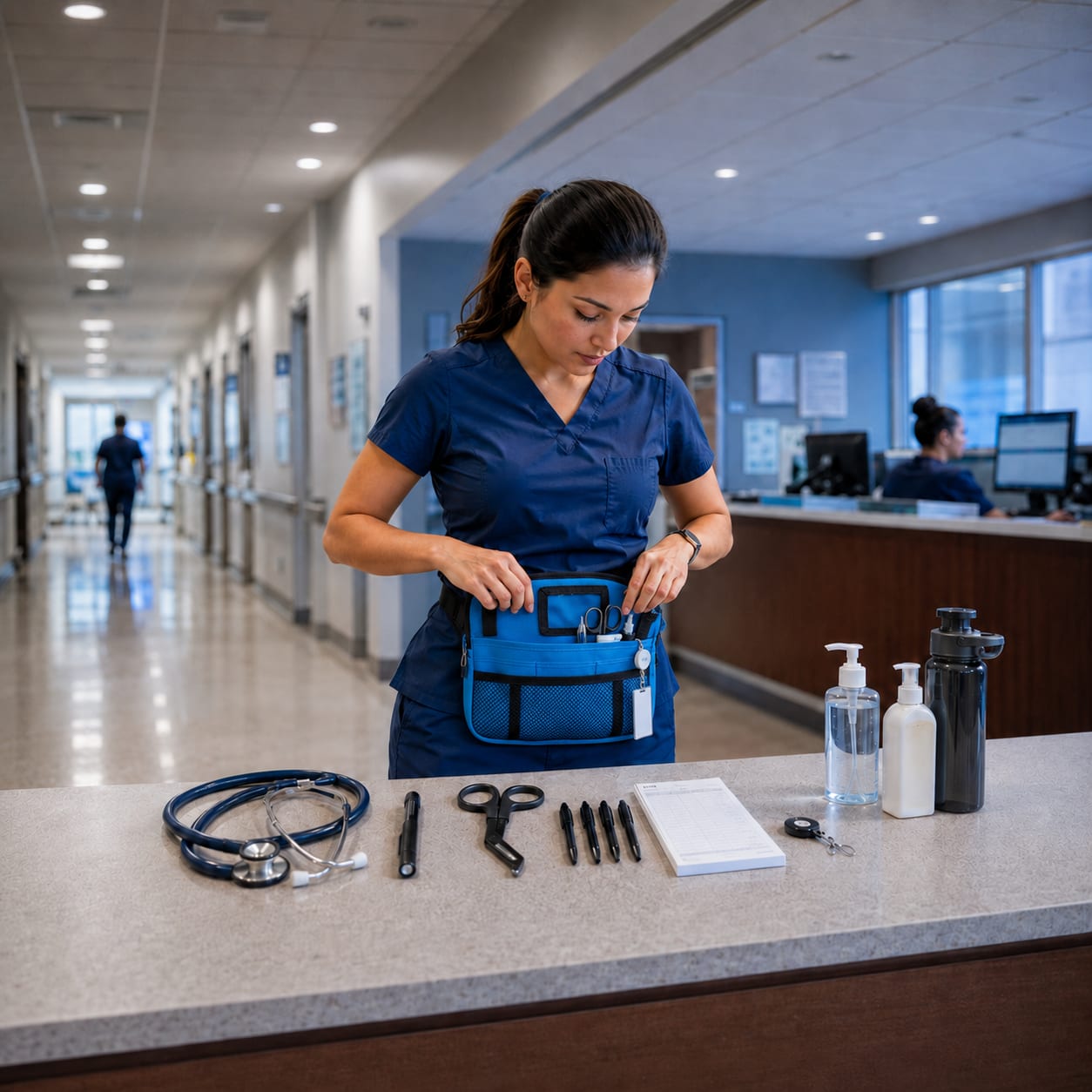
After working with nurses across Sacramento's healthcare settings, the core essentials are consistent across departments:
Stethoscope. Not loose, not around your neck all shift. A secure holder, whether magnetic or hook and loop, keeps it immediately accessible and removes the constant micro-adjustment that eats seconds you do not have.
Bandage scissors and a pen. These need to be reachable in under two seconds. A dedicated slot or elastic loop, not buried at the bottom of a pocket, is the standard.
Medical tape. Pre-cut pieces in an organized holder eliminate fumbling with the roll mid-procedure.
Alcohol wipes and hand sanitizer. Keeping these accessible encourages consistent use. Infection control does not happen if the supplies are inconvenient.
Gauze, small dressings, and bandages. Minor wound situations happen constantly. Being prepared avoids unnecessary trips away from the bedside.
Syringes and caps. These need their own space, separated from other supplies, to stay organized and maintain sterility.
Pocket notebook or brain sheet. Paper still outperforms hunting through an EMR screen during rounds, particularly when your cognitive load is already high.
Phone and ID badge. Secure and visible, without occupying pocket space you need for other things.
The difference between a scattered shift and a controlled one is not always about carrying more. Research on nursing cognitive workload confirms that nurses' ability to organize information and equipment directly affects clinical decision-making and patient outcomes, and that nurses facing higher cognitive load are more vulnerable to errors. A pack with dedicated compartments for each item reduces the number of small decisions and physical searches your brain has to execute across a shift.
The Cognitive Load Case for Organized Gear
This is worth being direct about, because it is often understated in discussions about nursing gear.
A scoping review of emergency nursing cognitive workload published in a peer-reviewed nursing journal found that nurses experiencing high cognitive mental workload due to interruptions and multitasking show measurable declines in vigilance, sensory processing, and decision-making due to limited cognitive resources. Research on clinician cognitive overload published in Nurse Leader describes working memory as the ability to hold and use relevant information while in the middle of an activity, and confirms that when nurses receive too many simultaneous inputs, they become overloaded and critical patient care tasks are more likely to be missed.
Disorganized gear is not just inconvenient. It adds to the stack of cognitive demands your brain is already managing during a high-acuity shift. Every time you search for scissors, dig for tape, or adjust a sliding stethoscope, you are spending working memory on a task that should require zero cognitive resources. Multiply that across a 12-hour shift and you can see how gear design becomes a patient safety issue, not just a comfort issue.
A pack with purpose-built compartments removes those micro-decisions from your mental load. The stethoscope is in the same place every time. The scissors are in the same place every time. That predictability is not trivial when you are making clinical decisions under pressure.
ED vs. ICU: The Setup Differs
What you carry depends on how you move through your shift, and ED and ICU nurses move very differently.
ED nurses prioritize speed and portability. You are in constant motion through triage, waiting room checks, and rapid room turnover. A lighter pack with external pockets and quick-grab design serves you better here. Many Sacramento ED nurses pair their fanny pack with a stethoscope holder that allows single-handed retrieval without unclipping, and keep their pack stripped down to absolute essentials so it moves with them rather than against them.
ICU nurses spend more time at the bedside working the same patient assignment across a shift. Your pack can carry more weight without the same mobility penalty. But ICU work requires greater compartmentalization: extra alcohol pads for line care, additional gauze for wound checks and line changes, gloves in multiple sizes, and small assessment tools. The priority here is not speed of retrieval but sterility discipline. Dedicated compartments that separate sterile from non-sterile supplies are non-negotiable, and a pack that lets you mix those categories will cost you time and create risk.
Both roles benefit from a stethoscope attachment that keeps the scope secured and both hands free. The specific type depends on your workflow, which is covered in the next section.
Magnetic vs. Hook and Loop: Which Holder Works for You
This question comes up consistently, and the honest answer is that it depends on your practice pattern.
Magnetic holders offer the fastest on-and-off access. If you are pulling your scope frequently for quick assessments throughout a shift, a magnetic clip removes the fumbling that comes with velcro during busy moments. The trade-off is compatibility: magnetic holders work best with stethoscopes that have metal earpieces, and they may not hold as securely during high-contact situations.
Hook and loop holders offer maximum security and universal compatibility. Your scope stays put regardless of stethoscope brand or earpiece material. They work well for nurses who prefer the scope attached throughout a shift or who work in environments where incidental contact is frequent, which describes most Sacramento ED hallways. The slight additional step of pulling the velcro is genuinely not a problem for nurses who are not retrieving their scope every few minutes.
The practical test is simple: think about how often you pull your scope per hour. Frequent, rapid retrieval favors magnetic. Secure, all-day attachment favors hook and loop. Some nurses keep both setups for different shift types.
What to Look for When Choosing a Pack
Based on the demands described above, a clinically useful fanny pack has these characteristics:
At least six to eight organized compartments, with clear separation between sterile and non-sterile storage. Durable water-resistant material that can be wiped down between patients. An ID badge window that keeps your badge visible without separate clipping. Adjustable straps that fit different body types and stay snug during rapid movement. A dedicated stethoscope attachment point, either built-in or compatible with a separate holder. Materials that do not absorb fluids or trap odors over a multi-shift week.
Generic waist packs fail in most of these categories. A pack designed specifically for clinical use accounts for the real-world conditions of a shift in ways that general accessories do not.
Gear That Was Built for Shifts Like Yours
At Bobcat Medical, our products are designed by healthcare professionals who have worked Sacramento's ED and ICU shifts. Every compartment, strap adjustment, and attachment point reflects input from nurses who told us what generic gear gets wrong.
Our nurse fanny packs are field-tested in actual clinical environments. Our stethoscope holders, both magnetic and hook and loop options, are built for the specific way nurses move. If something does not work for your shift, our 30-day money-back guarantee means you are not stuck with it.
Browse our full collection of nurse fanny packs and stethoscope holders. Free shipping on orders over $50 across the continental U.S.
Frequently Asked Questions
How much should a quality nurse fanny pack cost?
A quality pack typically runs between $35 and $85. Mid-range options in the $50 to $75 range tend to offer the best combination of durability, compartment design, and stethoscope attachment compatibility. Budget options often fail after a few months of hard clinical use, which ends up costing more in replacements than investing in something built to last.
Can I wash my nurse fanny pack regularly?
Yes, and you should. Most quality clinical packs are made from water-resistant polyester that handles spot cleaning with soap and water. Check your pack's specific care instructions, but in general, wipe-downs after shifts and periodic hand washing keep it clean and hygienic. Always air dry completely before your next shift.
What is the best way to organize a multi-compartment pack?
Organize by access frequency and sterility. Your stethoscope and most-reached-for items belong in the most accessible external pockets. Bulk supplies like extra gauze, gloves, and wipes go in the main compartment. Use dedicated smaller pockets to keep sterile supplies separate from non-sterile ones. Many ICU nurses designate one pocket exclusively for tape and dressings, another for pens and markers, so nothing requires searching.
Will a fanny pack interfere with monitor clipping or alarms?
Not when fitted correctly. A snug waist-level pack sits below where monitor clamps attach and should not interfere with telemetry systems. The key is adjusting the strap so the pack does not shift during movement. If you are starting with a new pack, wearing it during a lower-acuity shift first gives you a chance to adjust fit before relying on it during high-acuity care.
How do I know if a pack is designed for clinical use versus a generic waist pack?
Clinical packs include features generic options do not: dedicated stethoscope attachment, compartments sized for actual medical supplies including syringe holders, ID badge windows, and materials that resist bodily fluid absorption. Look for packs described specifically as nurse or medical accessories, designed with input from actual healthcare professionals, with at least six organized compartments. Reviews from RNs, ICU nurses, and ED staff who describe real shift conditions are your most reliable indicator.
Tags
Written by
Bobcat Medical Team
Delivering quality medical equipment and healthcare insights for nurses and healthcare professionals.
Related Articles

Magnetic Stethoscope Holder: Nursing Accessories for Men That Work
Male nurses need gear that keeps up with real shifts. Here's what actually works in high-pressure units, from magnetic stethoscope holders to nurse fanny packs.
The Complete Nurse Hospital Supply List for Every Shift
Every item on this supply list has a clinical reason to be there. From diagnostic tools to wellness gear, this research-backed guide covers what nurses, CNAs, and paramedics actually need on shift.

What to Eat on a 12-Hour Shift to Stay Sharp
Nurse nutrition is a patient safety issue, not just a personal health choice. This research-backed guide covers what to eat before, during, and after a 12-hour shift based on clinical evidence.
Browse Our Medical Equipment
Quality medical equipment at competitive prices. Trusted by clinics and practices nationwide.
Shop Now